
Skip to content

Sokoto™ Goatskin: The World’s Premier Archival Bookbinding Leather

All Things Leather

By Steven Siegel | Siegel Leather

Success brings imitation. And this is the reality of any market where a genuinely superior product builds a reputation. Sokoto™ goatskin has built that reputation over decades. And so, predictably, others have tried to copy it.

We discovered this firsthand when a straw buyer, on our behalf, purchased leather from a competitor marketing under a name nearly identical to ours. What arrived was instructive. The grain pattern was wrong. The spelling of the tannage agent was wrong — they wrote “begaruwa” rather than “bagaruwa,” which tells you they copied the label without understanding what it refers to. And when the leather was bent and subjected to stress, the grain and corium began to separate. That last detail matters enormously to anyone who intends for a binding to survive time.

This article exists because bookbinders, conservators, and collectors deserve to know exactly what they’re working with before they commit their project to a hide. What follows is a frank account of what genuine Sokoto™ goatskin is, what distinguishes it structurally and chemically, and what to look for when something presented as similar is, in fact, not.

Where Genuine Sokoto™ Comes From

The leather begins in northern Nigeria. The Nigerian Red Goat, raised by Fulani pastoralists in the Sokoxto region, produces a skin with an unusually high follicle density. Its follicle density is quite unique and it is what gives the leather its characteristic compact papillary structure and the tight, natural grain that conservators have relied on for fine bookbinding for generations.

To become the prized leather that it is, the skin is fundamentally passed through a series of processes.

Stage 1: Foundational Tanning Process

The first stage, the foundational tanning process, takes place in ground-set pits using Bagaruwa: the pods of Acacia nilotica, a botanical tannin source documented in West African leatherworking traditions and recorded by Freudenberg in his 1959 Hides and Skins Markets of the World — a privately published study obtained directly by Siegel Leather at publication. Bagaruwa forms part of a broader native-biologic tanning system that also includes traditional pigeon-dung bating, groundnut-oil lubrication, and sun-drying. No chromium. No synthetic shortcuts. The process is slow, and that slowness is the point: it allows tannin to penetrate gradually and evenly from grain through to the corium interior, rather than the rapid surface fixation characteristic of chrome tanning.

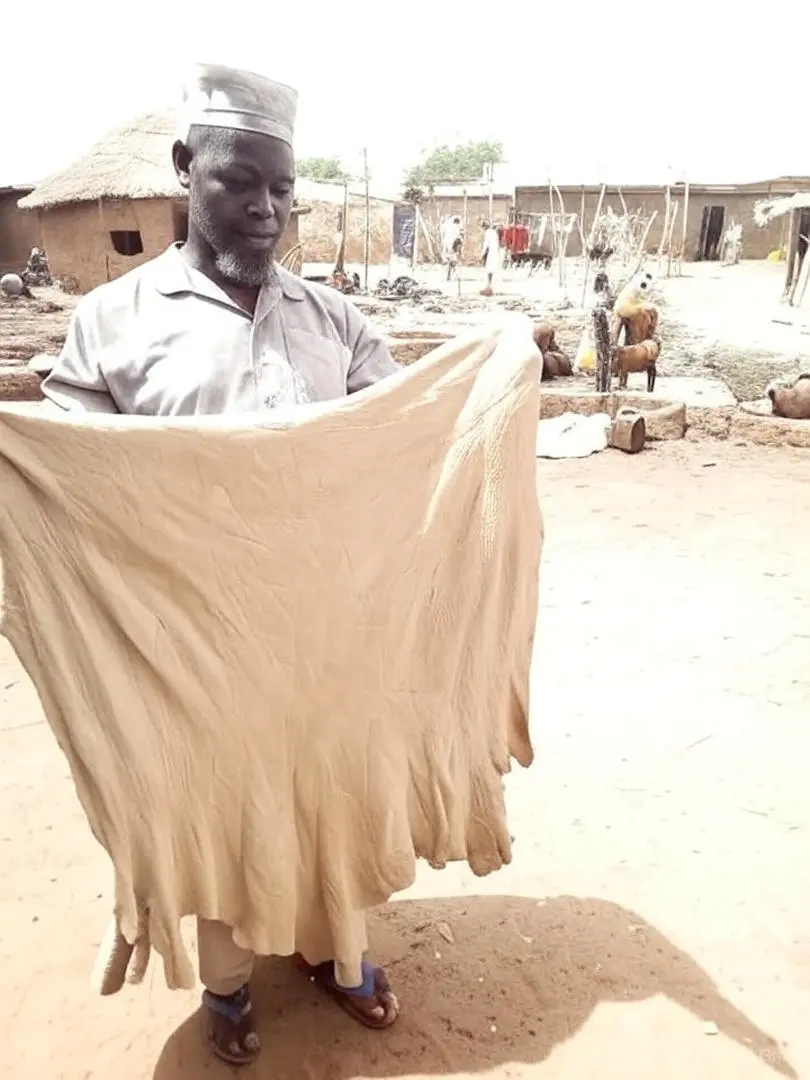
Genuine Sokoto™ crust leather fresh from the pits in Sokoto™, Nigeria. Ready to be retanned and colored. Note the natural, irregular river grain — no two skins are identical.

You can read more about this tanning tradition, and the historical documentation behind it, in our article Sokoto™ Goatskin: Tracing the Historical Roots of a Renowned Bookbinding Leather Tradition.

Stage 2: What Siegel Leather Adds

Traditional Nigerian crust leather and finished Sokoto™ archival leather are not the same material. This point is worth stating plainly, because some imitators stop at Stage 1 and claim equivalence. They do not understand — or do not care — that the archival performance of Sokoto™ is built in Stage 2. Copying the name without executing the process produces a different material entirely – a fake, a poor imitation of the original.

Following Stage 1 pit tanning, selected skins undergo a second controlled stage under Siegel Leather’s technical supervision in Western Europe. This is where the defining archival characteristics of Sokoto™ are established: vegetable retannage using appropriate tannin systems, pH stabilization, and sulfur-free finishing. All dyeing is performed at this stage. No coloration takes place in Nigeria.

The result is a material engineered for long-term stability — not surface appearance. We describe the full specification in our SOKOTO™ Conservation-Grade Goatskin Technical White Paper.

The Grain Is Not Decorative. It Is Structural.

The river grain of Sokoto™ is probably the most visually distinctive thing about it. It is also the feature most frequently faked.

What makes it different is this: the grain on genuine Sokoto™ forms organically during pit tanning, as tannins interact with the fiber structure and the skin dries under natural conditions. It is not uniform. It is not repetitive. It is the result of a biological and chemical process, and it looks like one.

Embossed grain — which is what imitations use — is imposed mechanically after the fact. Under a loupe, the difference is visible: embossed grain shows a regular, tessellated pattern. Natural grain does not. But you don’t always need a loupe. Often the uniformity is apparent with the naked eye to anyone who has handled both.

The more important difference is structural. When you bend leather with a naturally formed grain, the grain and the corium beneath it move together. They were formed and tanned as a unified structure. When you bend embossed leather, the mechanical process that imposed the grain has already stressed the grain-corium interface. On lower-quality hides where this was done to disguise an inadequate natural surface, that interface is often already compromised before the binder touches it. The grain separates. And this is not a theoretical risk — we saw it in the sample we purchased from the competitor.

The imitation. Artificial grain, loose corium, and a seller who couldn’t spell the tannage agent they claimed to use. You would encounter a lot of these in the market when you are not buying from Siegel Leather. 

The USDA documented the consequences of exactly this failure mode in library bindings across American collections. Their 1930 Leaflet No. 69 — authored by chemists Frey and Veitch — remains one of the most thorough analyses of leather deterioration in institutional use. The relevant finding is straightforward: when the grain-corium interface is compromised, failure at the joints is not a question of if, only when. We discuss the USDA research in depth in our piece on premium bookbinding leather durability.

Full Grain Is Not a Marketing Term. It Is a Standard.

Sokoto™ is processed to the classical full-grain standard: hair removal only, with no sodium sulfide applied to the grain surface, no sanding, no buffing, no grain correction. The natural papillary layer is preserved intact. This is what allows the leather to receive gold tooling cleanly, to pare predictably, and to age without the surface failure that plagues mechanically altered hides.

We have written at length about the gap between the classical definition of full grain leather and what the term often means in commercial practice today. If you are sourcing leather described as full grain without asking specifically about buffing, embossing, or surface correction, you may be getting something quite different from what that phrase implies. See our article Full Grain Leather: Classical vs. EU Definition for the full picture.

Chrome in a Vegetable-Tanned Leather Is Not a Minor Issue

Testing of competing products marketed under similar names has confirmed the presence of chrome residues. This is not a technicality. It is a fundamental misrepresentation of the material.

Here is what chrome tanning is: a fast, industrially efficient process that fixes tannins into the hide in hours rather than weeks. It produces a soft, consistent, commercially reliable product. It is used widely across the leather industry for shoes, bags, and upholstery. But it is chemically incompatible with archival bookbinding — and any seller claiming to offer a Bagaruwa-tanned vegetable leather while delivering a chrome-tanned product either does not understand the chemistry or is counting on you not to notice. 

The 1905 Royal Society of Arts Committee on Leather for Bookbinding was unequivocal on the subject of chemically treated and industrially processed leathers. Their findings, which remain the most authoritative scientific analysis of leather deterioration ever conducted, established the tannage chemistry as the primary determinant of long-term stability. We cover this history in our Leather Knowledge Series.

Our Sokoto™ production batches are tested to confirm non-detectable chromium content. That testing is part of the specification, and a guarantee of true quality.

How to Identify Genuine Sokoto™: A Practical Guide

Here is what to look for. These are not aesthetic preferences. They are structural and chemical facts.

What to Look ForGenuine Sokoto™What Imitations Show
Grain patternNatural river grain — tight, irregular, formed organically during pit tanningUniform, repetitive pattern — a telltale sign of mechanical embossing
Grain–corium bondStays intact under bending; grain and corium move as oneGrain lifts or separates at flex points, particularly at joints and hinges
Tannage claimVerified Bagaruwa (Acacia nilotica), correctly spelled, documented“Begaruwa” or other misspellings — copied without understanding the chemistry
Chrome contentNon-detectable in tested batchesChrome residues detected in tested competing products
Certificate of AuthenticityNumbered seal, batch traceable from pastoralist source to finished leatherNone, or generic unverifiable labeling
DyeingAll coloration done under Siegel Leather’s controlled Stage 2 retanning — none in NigeriaOrigin and dyeing process undisclosed

The Certificate of Authenticity Is Not Ceremonial

Every Sokoxto Traditional™ skin supplied by Siegel Leather carries a numbered Certificate of Authenticity with a formal seal. The authentication seal is a chain-of-custody documentation that enables institutional purchasers to trace the material to source.

The certificate documents breed and geographic origin (Nigerian Red Goat, northern Nigeria); the Stage 1 tanning agents and processes (Bagaruwa, pigeon-dung bating, groundnut-oil lubrication, sun-drying, ground-set pit tanning); and Stage 2 processing parameters under Siegel Leather’s specification. Batch-level pH and shrinkage temperature data are included.

No imitator has this. They cannot, because the documentation traces a process that is Siegel Leather’s — not a name they copied, but a two-stage system developed, specified, and verified over decades.

What the 1905 Committee Said About Imitation

The 1905 Royal Society of Arts committee on leather for bookbinding did not mince words about artificially grained and embossed leathers. Their recommendation, adopted by His Majesty’s Stationery Office, was explicit: the binder undertakes not to use leather embossed or grained artificially. This was not an aesthetic preference. It was grounded in documented evidence that mechanically altered grain fails — that the surface correction disguises structural weakness that manifests later, in the joints, under stress, across time.

We have had that finding sitting in our reference library for a long time. It did not surprise us when the sample we purchased from our imitator showed grain-corium separation on bending. The committee documented exactly that failure mode over a century ago. What is remarkable is that the people selling these imitations apparently have not read the literature. Or perhaps they have, and are relying on the assumption that their buyers have not. You can read the full report and our analysis in Leather for Libraries: Why It Still Matters Today.

A Note on Availability

We recently received a hand-delivered sample package from Sokoxto for personal review of the latest production. The hides are outstanding. We maintain an excellent inventory of our core 16 colors — Black, Navy Blue, Red 104, Brown 205, Purple, British Tan, Grey, and others — all available in standard cut sizes, with a full shipment underway.

Every piece of Sokoto™ we sell carries a numbered seal of authenticity. That is your guarantee of what you are actually getting.

If you have questions about identifying genuine Sokoto™, or if you have encountered a product claiming similar characteristics and want a second opinion, contact us. We are happy to talk through specifics. This is the kind of conversation we have been having with bookbinders and conservators for a very long time.

Browse Sokoto™ Goatskin ? siegelleather.com/product/sokoto-goat/

Related Reading from the Siegel Leather Blog

About the Author — Steven Siegel is the owner of Siegel Leather and has served as an expert witness in leather-related cases for over two decades. His work is informed by historical research, archival analysis, and the scientific literature on leather deterioration, including the British Committee’s 1905 report and the USDA’s multi-decade research program.

How to Spot Genuine Sokoto™ Goatskin — And Why Imitations Fall Short

By Steven Siegel | Siegel Leather

Success brings imitation. And this is the reality of any market where a genuinely superior product builds a reputation. Sokoto™ goatskin has built that reputation over decades. And so, predictably, others have tried to copy it.

We discovered this firsthand when a straw buyer, on our behalf, purchased leather from a competitor marketing under a name nearly identical to ours. What arrived was instructive. The grain pattern was wrong. The spelling of the tannage agent was wrong — they wrote “begaruwa” rather than “bagaruwa,” which tells you they copied the label without understanding what it refers to. And when the leather was bent and subjected to stress, the grain and corium began to separate. That last detail matters enormously to anyone who intends for a binding to survive time.

This article exists because bookbinders, conservators, and collectors deserve to know exactly what they’re working with before they commit their project to a hide. What follows is a frank account of what genuine Sokoto™ goatskin is, what distinguishes it structurally and chemically, and what to look for when something presented as similar is, in fact, not.

Where Genuine Sokoto™ Comes From

The leather begins in northern Nigeria. The Nigerian Red Goat, raised by Fulani pastoralists in the Sokoxto region, produces a skin with an unusually high follicle density. Its follicle density is quite unique and it is what gives the leather its characteristic compact papillary structure and the tight, natural grain that conservators have relied on for fine bookbinding for generations.

To become the prized leather that it is, the skin is fundamentally passed through a series of processes.

Stage 1: Foundational Tanning Process

The first stage, the foundational tanning process, takes place in ground-set pits using Bagaruwa: the pods of Acacia nilotica, a botanical tannin source documented in West African leatherworking traditions and recorded by Freudenberg in his 1959 Hides and Skins Markets of the World — a privately published study obtained directly by Siegel Leather at publication. Bagaruwa forms part of a broader native-biologic tanning system that also includes traditional pigeon-dung bating, groundnut-oil lubrication, and sun-drying. No chromium. No synthetic shortcuts. The process is slow, and that slowness is the point: it allows tannin to penetrate gradually and evenly from grain through to the corium interior, rather than the rapid surface fixation characteristic of chrome tanning.

Genuine Sokoto™ crust leather fresh from the pits in Sokoto™, Nigeria. Ready to be retanned and colored. Note the natural, irregular river grain — no two skins are identical.

You can read more about this tanning tradition, and the historical documentation behind it, in our article Sokoto™ Goatskin: Tracing the Historical Roots of a Renowned Bookbinding Leather Tradition.

Stage 2: What Siegel Leather Adds

Traditional Nigerian crust leather and finished Sokoto™ archival leather are not the same material. This point is worth stating plainly, because some imitators stop at Stage 1 and claim equivalence. They do not understand — or do not care — that the archival performance of Sokoto™ is built in Stage 2. Copying the name without executing the process produces a different material entirely – a fake, a poor imitation of the original.

Following Stage 1 pit tanning, selected skins undergo a second controlled stage under Siegel Leather’s technical supervision in Western Europe. This is where the defining archival characteristics of Sokoto™ are established: vegetable retannage using appropriate tannin systems, pH stabilization, and sulfur-free finishing. All dyeing is performed at this stage. No coloration takes place in Nigeria.

The result is a material engineered for long-term stability — not surface appearance. We describe the full specification in our SOKOTO™ Conservation-Grade Goatskin Technical White Paper.

The Grain Is Not Decorative. It Is Structural.

The river grain of Sokoto™ is probably the most visually distinctive thing about it. It is also the feature most frequently faked.

What makes it different is this: the grain on genuine Sokoto™ forms organically during pit tanning, as tannins interact with the fiber structure and the skin dries under natural conditions. It is not uniform. It is not repetitive. It is the result of a biological and chemical process, and it looks like one.

Embossed grain — which is what imitations use — is imposed mechanically after the fact. Under a loupe, the difference is visible: embossed grain shows a regular, tessellated pattern. Natural grain does not. But you don’t always need a loupe. Often the uniformity is apparent with the naked eye to anyone who has handled both.

The more important difference is structural. When you bend leather with a naturally formed grain, the grain and the corium beneath it move together. They were formed and tanned as a unified structure. When you bend embossed leather, the mechanical process that imposed the grain has already stressed the grain-corium interface. On lower-quality hides where this was done to disguise an inadequate natural surface, that interface is often already compromised before the binder touches it. The grain separates. And this is not a theoretical risk — we saw it in the sample we purchased from the competitor.

The imitation. Artificial grain, loose corium, and a seller who couldn’t spell the tannage agent they claimed to use. You would encounter a lot of these in the market when you are not buying from Siegel Leather. 

The USDA documented the consequences of exactly this failure mode in library bindings across American collections. Their 1930 Leaflet No. 69 — authored by chemists Frey and Veitch — remains one of the most thorough analyses of leather deterioration in institutional use. The relevant finding is straightforward: when the grain-corium interface is compromised, failure at the joints is not a question of if, only when. We discuss the USDA research in depth in our piece on premium bookbinding leather durability.

Full Grain Is Not a Marketing Term. It Is a Standard.

Sokoto™ is processed to the classical full-grain standard: hair removal only, with no sodium sulfide applied to the grain surface, no sanding, no buffing, no grain correction. The natural papillary layer is preserved intact. This is what allows the leather to receive gold tooling cleanly, to pare predictably, and to age without the surface failure that plagues mechanically altered hides.

We have written at length about the gap between the classical definition of full grain leather and what the term often means in commercial practice today. If you are sourcing leather described as full grain without asking specifically about buffing, embossing, or surface correction, you may be getting something quite different from what that phrase implies. See our article Full Grain Leather: Classical vs. EU Definition for the full picture.

Chrome in a Vegetable-Tanned Leather Is Not a Minor Issue

Testing of competing products marketed under similar names has confirmed the presence of chrome residues. This is not a technicality. It is a fundamental misrepresentation of the material.

Here is what chrome tanning is: a fast, industrially efficient process that fixes tannins into the hide in hours rather than weeks. It produces a soft, consistent, commercially reliable product. It is used widely across the leather industry for shoes, bags, and upholstery. But it is chemically incompatible with archival bookbinding — and any seller claiming to offer a Bagaruwa-tanned vegetable leather while delivering a chrome-tanned product either does not understand the chemistry or is counting on you not to notice. 

The 1905 Royal Society of Arts Committee on Leather for Bookbinding was unequivocal on the subject of chemically treated and industrially processed leathers. Their findings, which remain the most authoritative scientific analysis of leather deterioration ever conducted, established the tannage chemistry as the primary determinant of long-term stability. We cover this history in our Leather Knowledge Series.

Our Sokoto™ production batches are tested to confirm non-detectable chromium content. That testing is part of the specification, and a guarantee of true quality.

How to Identify Genuine Sokoto™: A Practical Guide

Here is what to look for. These are not aesthetic preferences. They are structural and chemical facts.

What to Look ForGenuine Sokoto™What Imitations Show
Grain patternNatural river grain — tight, irregular, formed organically during pit tanningUniform, repetitive pattern — a telltale sign of mechanical embossing
Grain–corium bondStays intact under bending; grain and corium move as oneGrain lifts or separates at flex points, particularly at joints and hinges
Tannage claimVerified Bagaruwa (Acacia nilotica), correctly spelled, documented“Begaruwa” or other misspellings — copied without understanding the chemistry
Chrome contentNon-detectable in tested batchesChrome residues detected in tested competing products
Certificate of AuthenticityNumbered seal, batch traceable from pastoralist source to finished leatherNone, or generic unverifiable labeling
DyeingAll coloration done under Siegel Leather’s controlled Stage 2 retanning — none in NigeriaOrigin and dyeing process undisclosed

The Certificate of Authenticity Is Not Ceremonial

Every Sokoxto Traditional™ skin supplied by Siegel Leather carries a numbered Certificate of Authenticity with a formal seal. The authentication seal is a chain-of-custody documentation that enables institutional purchasers to trace the material to source.

The certificate documents breed and geographic origin (Nigerian Red Goat, northern Nigeria); the Stage 1 tanning agents and processes (Bagaruwa, pigeon-dung bating, groundnut-oil lubrication, sun-drying, ground-set pit tanning); and Stage 2 processing parameters under Siegel Leather’s specification. Batch-level pH and shrinkage temperature data are included.

No imitator has this. They cannot, because the documentation traces a process that is Siegel Leather’s — not a name they copied, but a two-stage system developed, specified, and verified over decades.

What the 1905 Committee Said About Imitation

The 1905 Royal Society of Arts committee on leather for bookbinding did not mince words about artificially grained and embossed leathers. Their recommendation, adopted by His Majesty’s Stationery Office, was explicit: the binder undertakes not to use leather embossed or grained artificially. This was not an aesthetic preference. It was grounded in documented evidence that mechanically altered grain fails — that the surface correction disguises structural weakness that manifests later, in the joints, under stress, across time.

We have had that finding sitting in our reference library for a long time. It did not surprise us when the sample we purchased from our imitator showed grain-corium separation on bending. The committee documented exactly that failure mode over a century ago. What is remarkable is that the people selling these imitations apparently have not read the literature. Or perhaps they have, and are relying on the assumption that their buyers have not. You can read the full report and our analysis in Leather for Libraries: Why It Still Matters Today.

A Note on Availability

We recently received a hand-delivered sample package from Sokoxto for personal review of the latest production. The hides are outstanding. We maintain an excellent inventory of our core 16 colors — Black, Navy Blue, Red 104, Brown 205, Purple, British Tan, Grey, and others — all available in standard cut sizes, with a full shipment underway.

Every piece of Sokoto™ we sell carries a numbered seal of authenticity. That is your guarantee of what you are actually getting.

If you have questions about identifying genuine Sokoto™, or if you have encountered a product claiming similar characteristics and want a second opinion, contact us. We are happy to talk through specifics. This is the kind of conversation we have been having with bookbinders and conservators for a very long time.

Browse Sokoto™ Goatskin ? siegelleather.com/product/sokoto-goat/

Related Reading from the Siegel Leather Blog

About the Author — Steven Siegel is the owner of Siegel Leather and has served as an expert witness in leather-related cases for over two decades. His work is informed by historical research, archival analysis, and the scientific literature on leather deterioration, including the British Committee’s 1905 report and the USDA’s multi-decade research program.

SOKOTO™ Conservation-Grade Goatskin, A Technical White Paper

Sokoto™ refers specifically to the finished archival leather produced through the traditional Sokoto™ tanning stage followed by Siegel Leather’s exclusive retanning and finishing process. Siegel Leather is the sole authorized producer of Sokoto™ leather as defined by this documented specification and quality standard.

1. Introduction

The preservation of cultural heritage depends on materials that can endure decades, or centuries, of mechanical stress, environmental fluctuation, and the chemical demands of institutional storage. Among the leathers entrusted with this mandate, Sokoto™ conservation-grade goatskin, a proprietary archival leather line developed and curated by Siegel Leather, occupies a singular position. The historical Nigerian crust leather represents only the foundational first stage of production. Sokoto™ refers exclusively to the finished archival leather produced after Siegel Leather’s proprietary retanning, coloring, and finishing processes. Traditional Nigerian crust leather and finished Sokoto™ archival leather are not identical materials. The traditional crust stage provides the foundational fiber structure and tannin chemistry, while the defining archival characteristics of Sokoto™ are achieved through Siegel Leather’s proprietary Stage 2 retanning, coloring, and finishing processes.  Siegel Leather is the sole authorized producer of Sokoto™ goatskin within the bookbinding trade, producing the finished archival leather according to its documented and verifiable specification.

Distinguished from commodity bookbinding leathers by its documented tannage chemistry, intact grain-to-corium architecture, and provenance-verified supply chain, Sokoto™ is engineered for the needs of conservators, edition binders, and institutional collections worldwide. This white paper presents a peer-reviewed and field-supported technical profile, covering tannin chemistry, hydrothermal stability, structural integrity, finishing protocols, and compliance with international archival standards.

2. Ethnographic Documentation and Material Heritage

The tanning tradition underlying Sokoto™ is among the most thoroughly documented in the ethnographic literature on West African leather production. Freudenberg’s Hides and Skins Markets of the World (1959), a privately published study obtained directly by Siegel Leather at publication, provides foundational documentation of the Bagaruwa-based tanning practices used in northern Nigerian goatskin production. Freudenberg identified the use of Acacia nilotica pods, known as Bagaruwa (Hausa, Nigeria), as the primary tanning agent applied to Nigerian Red Goat skins sourced from Fulani pastoralists in the region. Bagaruwa forms one key component of a broader native-biologic tanning system that also incorporates traditional pigeon-dung bating, groundnut-oil lubrication, sun-drying, and related indigenous processing methods used in northern Nigerian goatskin production. These historical references primarily describe the traditional Nigerian crust leather stage rather than the completed Sokoto™ archival leather produced under Siegel Leather’s proprietary finishing specification. The complete formulation and sequencing of these traditional stages, as incorporated within Siegel Leather’s Sokoto™ specification, are not publicly disclosed. The unusually high follicle density of Nigerian Red Goats contributes significantly to the compact papillary structure and natural river-grain characteristics that distinguish the material from goatskins sourced in neighboring regions, Asia, or other global leather-producing areas. 

The Royal Society of Arts Report of the Committee on Leather for Bookbinding (1905) independently recognized vegetable-tanned Nigerian goatskin materials historically classified within the “Morocco” trade as benchmark bookbinding leathers due to their durability and resistance to deterioration, describing it as uniquely resistant to the powdering, embrittlement, and delamination that afflicts inferior tannages. The renowned Arts and Crafts bookbinder Douglas Cockerell further validated the material through documented use in institutional and fine-binding commissions whose surviving examples remain in museum collections today. These historical references describe precursor trade materials rather than the finished Sokoto™ archival leather designation introduced and formalized by Siegel Leather. 

Siegel Leather’s Sokoto™ line preserves and formalizes this tradition. Sokoto™ refers specifically to the finished archival leather produced through the traditional Sokoto™ tanning stage followed by Siegel Leather’s exclusive retanning and finishing process. Leather produced in the Sokoto™ region does not automatically meet this standard; only material produced according to Siegel Leather’s defined and verifiable specification qualifies as Sokoto™ conservation-grade leather.

The trademarked designation applies specifically to skins produced according to Siegel’s documented specification: Nigerian Red Goats traditionally pit-tanned with Bagaruwa and other native biologics, including traditional pigeon-dung bating and groundnut-oil lubrication, and subsequently processed through Siegel’s controlled retannage and finishing program to produce the finished archival Sokoto™ leather.

The Sokoto™ mark is not a generic term for all leather originating from the Sokoto™ region, but a quality and process certification owned by Siegel Leather, designed to distinguish authentic conservation-grade material from imitations — including chrome-tanned skins whose residues have been detected in competing products bearing similar names.

3. Grain/Corium Interface Integrity

The structural reliability of bookbinding leather depends critically on the relationship between the grain layer, the tight, fine-fibered outer surface, and the corium, the denser fibrous sublayer that provides tensile strength and dimensional stability. When this interface is compromised through splitting, excessive buffing, or chemical over-processing, the leather becomes prone to delamination under the mechanical stresses of turning, pulling, and rebacking.

Sokoxto Traditional™ is processed to the classical full-grain standard: hair removal only, with no sodium sulfide, sanding, buffing, or grain correction applied to the surface. This preserves the natural tight-weave architecture of the papillary layer and maintains the continuity of the grain-corium bond across the full skin. Conservation cross-section analysis reveals an unusually even distribution of collagen bundles through the corium, with a high-density papillary zone that grades gradually into the reticular layer, a morphology that resists cleavage and supports the paring characteristic critical in bookbinding.

Scanning electron microscopic analysis reported in vegetable-tanned leather research literature suggests that Bagaruwa-based tannage can produce relatively uniform tannin penetration from grain through to the corium interior when compared with rapid chrome fixation systems. This uniformity means Sokoto™ behaves predictably under paring, responding consistently without the uneven compression or unexpected tear that characterizes heterogeneously tanned skins. The characteristic river-grain pattern of Sokoxto Traditional™ is a direct product of the intact papillary layer topology and cannot be convincingly replicated through embossing or mechanical grain manipulation. 

4. Finishing Methods

Sokoto™ finishing protocols are designed to maximize long-term chemical inertness while preserving the tooling sensitivity and aesthetic responsiveness demanded by fine binders. 

Sokoto™ Morocco is a distinct variant produced according to Siegel Leather’s proprietary retannage and finishing specification.

The Stage 2 retannage, coloring, and finishing operations are performed in Western Europe under Siegel Leather’s technical supervision. No dyeing is performed in Nigeria; all coloration is completed during Siegel Leather’s controlled retanning and finishing stage. This controlled second-stage process is a defining component of the finished archival Sokoto™ leather specification.

5. Archival Standards and Regulatory Considerations

Sokoto™ is produced with the objective of meeting the material-performance requirements expected by conservators, bookbinders, and institutional collections. Its traditional Bagaruwa-based tanning foundation and proprietary finishing process are intended to support long-term durability and conservation suitability.

The formulation and manufacturing approach reflect principles discussed in conservation and leather-research literature, including work undertaken through the STEP Leather Project (Protection and Conservation of European Cultural Heritage, Research Report 1), which examined factors associated with long-term leather stability.

6. Provenance and Certification

Institutional purchasers and individual conservators alike require material certainty. Each Sokoxto Traditional™ skin supplied by Siegel Leather is accompanied by a formal Certificate of Authenticity bearing an official seal and a unique traceable identification number, enabling chain-of-custody documentation that satisfies institutional acquisition standards and supports future conservation records.

The certification framework documents: breed and geographic origin (Nigerian Red Goat, Fulani pastoralist supply network within northern Nigeria and the Sokoto™ region); Stage 1 tanning agents and processes (Bagaruwa, Acacia nilotica pods, together with other native biologics including traditional pigeon-dung bating, groundnut-oil lubrication, sun-drying, and ground-set pit processing methods); Stage 2 processing parameters (Siegel Leather’s proprietary Western European retannage and finishing specification conducted under Siegel’s technical supervision); and batch-level pH and shrinkage temperature data.

Historically, related precursor materials were frequently referenced within the trade as “Niger” or “Nigerian goatskin.” These historical trade classifications referred to regional vegetable-tanned goatskin materials rather than the finished Sokoto™ archival leather designation introduced and formalized by Siegel Leather at the turn of the 21st century. Sokoto™ is Siegel Leather’s modern commercial designation for the defined archival process, specification, and conservation-grade standard described herein.

Sokoto™ therefore refers not merely to a geographic source or traditional crust tannage, but to the completed archival leather system defined by Siegel Leather’s verified retanning, coloring, finishing, and certification protocols. This provenance architecture distinguishes Sokoto™ from the growing volume of imitation materials currently circulating in the bookbinding market. Testing has confirmed chrome residues in competing products marketed using similar terminology, materials that, regardless of surface appearance, fail the chemical criteria for archival classification and whose long-term behaviour in institutional collections remains unvalidated.

7. Conclusion

Sokoto™ conservation-grade goatskin from Siegel Leather represents the integration of centuries of ethnographically documented craft practice with modern analytical standards. The material’s performance derives from a coordinated two-stage system. The foundational structural characteristics originate from Nigerian Red Goat skins traditionally processed through Bagaruwa-based crust tanning methods, while the final archival stability, coloration, flexibility, and conservation-grade performance are achieved through Siegel Leather’s proprietary retanning and finishing specification. The intact grain-corium architecture of full-grain Nigerian Red Goat; the pH-controlled, acid-free finishing sequence; and the provenance certification that makes Sokoto™ the only archival goatskin line traceable from pastoralist source to institutional binding.

For conservators specifying materials for rebacking, new covers, or archival edition bindings, and for institutions establishing procurement standards that will govern collections for generations, Sokoto™ offers a technically validated, historically grounded, and legally certified answer. In a market where the word “archival” is applied without chemical evidence, Sokoto™ is the benchmark.

References

[1] Report of the Committee on Leather for Bookbinding. Royal Society of Arts, London, 1905.

[2] Covington, A.D. Tanning Chemistry: The Science of Leather. Royal Society of Chemistry, 2009.

[3] Freudenberg, K. Hides and Skins Markets of the World. Privately Published, 1959.

[4] STEP Leather Project — Evaluation of Archival Leathers for Conservation Applications. European Commission Research Programme.

[5] Larsen, R. Improved Damage Assessment of Parchment and Leather in Conservation. European Commission Research Report.

Sokoto™ Goatskin: The World’s Premier Archival Bookbinding Leather

Sokoto™ goatskin is the finished archival leather produced through the traditional Sokoxto tanning stage followed by our exclusive retanning and finishing process, under the direction of Siegel Leather. While historical documentation describes pre-industrial tanning practices associated with the Sokoxto region of northern Nigeria, leather produced there today does not automatically meet archival standards. The Sokoto™ designation is used to identify skins produced according to a defined specification and verified processing method.

The material is sourced from Nigerian Red Goats raised by Fulani pastoralists and initially pit-tanned using Bagaruwa (Acacia nilotica) pods in a traditional, chrome-free vegetable process. Following this first stage, skins are inspected and selected, then undergo a second stage of controlled processing under Siegel’s technical supervision. This includes vegetable retannage using appropriate tannin systems, historically consistent dyeing methods, and careful handling to preserve the grain–corium structure.

Used by conservators at institutions including the Harvard Library System and the Smithsonian Institution, Sokoto™ is supported by batch documentation, traceability systems, and laboratory verification of key material properties.


What Is Sokoto™ Leather?

Sokoto™ is not a commodity material. It is a trademarked designation used by Siegel Leather to describe a defined quality standard and production process. Sokoto™ refers to the finished archival leather produced through the traditional Sokoxto tanning stage followed by our exclusive retanning and finishing process.

Leather produced in the Sokoxto region does not inherently meet this standard. The designation distinguishes material that follows a documented process and meets criteria associated with conservation-grade performance.

Testing of commercially available leathers marketed under similar terminology has, in some cases, identified the presence of chrome residues. While chrome-tanned leathers are widely used in other industries, they are generally not considered suitable for long-term archival bookbinding applications.


Historical Origins and Cultural Provenance

The tanning tradition underlying Sokoto™ is documented in established literature. Freudenberg’s Hides and Skins Markets of the World (1959) records the use of Bagaruwa (Acacia nilotica pods) in the vegetable tanning of Nigerian Red Goat skins.

Historically, skins from this region were transported along Trans-Saharan trade routes to North Africa and Europe, where they were commonly referred to as “Niger Morocco” or “Nigerian goatskin,” valued for their durability, grain structure, and longevity.

The Royal Society of Arts Committee on Leather for Bookbinding (1905), in its published report, identified vegetable-tanned goatskin from this region as among the most suitable materials for high-quality bookbinding due to its resistance to deterioration.

Sokoto™ leathers today are produced with reference to these historical materials and practices. Siegel Leather adopted, introduced and popularized the designation “Sokoto™” at the turn of the 21st century to define and distinguish this specific material standard from broader or inconsistently applied historical terminology.


The Authentic Two Stage Tanning Process

Stage 1: Traditional Pit Tanning in Nigeria

The first stage of Sokoto™ production takes place in northern Nigeria using long-established methods. Skins are prepared and tanned in ground-set pits using Bagaruwa and other botanical extracts.

Key characteristics of this stage include:

  • Vegetable tannage using Bagaruwa (Acacia nilotica), a condensed tannin source
  • Processing in ground pits, allowing gradual and even tannin penetration
  • Traditional bating methods to open fiber structure
  • Use of natural oils for lubrication
  • Absence of chrome and synthetic tanning agents

This process produces the naturally occurring “river-grain” pattern associated with Sokoto™ goatskin, reflecting the structure of the papillary layer and the distribution of tannins through the hide.


Stage 2: Retanning and Coloring Under Technical Supervision

Following inspection, selected skins undergo a second stage of processing under controlled conditions. This stage includes:

  • Vegetable retannage using appropriate tannin systems
  • No dyeing is performed in Nigeria; all coloration is done during our controlled retanning and finishing stage.
  • Avoidance of chrome, azo dyes, and film-forming finishes
  • Process control to maintain structural integrity and flexibility

This second stage contributes to the long-term stability and consistency required for conservation-grade applications. Production batches are routinely tested to verify compliance with material standards, including confirmation of non-detectable chromium content.


Full Grain Standard: Grain Corium Interface Integrity

Sokoto™ goatskin is produced to maintain full-grain characteristics. Hair removal is carried out without abrasive surface correction, preserving the natural grain layer.

Key features include:

  • No sanding or buffing of the grain surface
  • Aniline dyeing without pigment coating
  • Naturally occurring grain pattern formed during tanning
  • Preservation of the grain–corium interface

Maintaining this structure supports durability and performance in applications such as gold tooling and fine binding. Mechanically altered or embossed leathers may not retain the same structural integrity.


Laboratory Verification and Material Testing

Material verification forms part of the Sokoto™ production process. Testing protocols may include:

  • Analysis for chromium content (Cr III and Cr VI)
  • Evaluation of shrinkage temperature
  • Screening for restricted substances under applicable standards

Testing is conducted on production batches to support consistency and compliance with conservation-oriented material expectations.


Technical Specifications

Colors Available
23 archival aniline colors

Tannage
Vegetable tannage using Bagaruwa (Acacia nilotica) and related botanical extracts

Finish
Full aniline, no surface pigment coating

Grain
Natural grain pattern formed during pit tanning

Chrome Content
Non-detectable in tested batches

Compliance
Aligned with relevant material safety and conservation-related standards

Applications
Archival bookbinding, restoration, fine binding, and conservation use


Certificate of Authenticity and Traceability

Sokoto™ goatskin is supported by a traceability system linking individual skins or batches to documentation.

Documentation may include:

  • Production batch identification and date
  • Source verification within the supply chain
  • Confirmation of processing methods
  • Statements regarding grain integrity and handling

Supporting documentation may also include references to traditional material practices.

Institutional Use and Professional Application

Siegel Leather supplies specialty leathers used in institutions including the Harvard Library System and the Smithsonian Institution. Materials designated as Sokoto™ are used in contexts where long-term durability and material stability are required.

The material is used by conservators, bookbinders, and publishers working on restoration, archival binding, and fine edition production.


Frequently Asked Questions

What is Sokoto™ leather?
Sokoto™ is a trademarked designation used by Siegel Leather for the finished archival leather produced through the traditional Sokoxto tanning stage followed by our exclusive retanning and finishing process.

What is Bagaruwa tanning?
Bagaruwa refers to the pods of Acacia nilotica, used as a source of vegetable tannins in traditional tanning processes in West Africa.

Is Sokoto™ leather chrome-free?
Testing of production batches has indicated non-detectable levels of chromium.

What is the river-grain pattern?
A natural surface pattern formed during pit tanning, associated with the structure of the grain layer.

Can it be used for gold tooling?
Yes. Full-grain structure and aniline finishing support tooling applications.

Is Sokoto™ the same as Niger Morocco?
It is a modern, process-defined designation developed by Siegel Leather, referencing a historically similar class of vegetable-tanned goatskin.

What does the Certificate include?
Batch-level traceability and supporting production documentation.

Where can I buy it?
Available through Siegel Leather.


Ready to Experience the Standard?

Sokoxto Traditional™ is available in 23 archival aniline colors, with documented production and material testing supporting its use in conservation and fine binding.

Whether for restoration, new binding, or long-term archival projects, Sokoto™ offers a material option aligned with established conservation practices.